TWISTED-RL: Hierarchical Skilled Agents for Knot-Tying without Human Demonstrations

ICRA 2026

G Freund, T Jurgenson,M Sudry, E Karpas

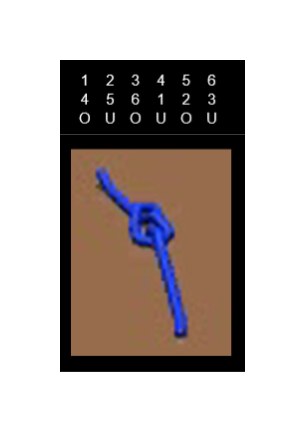
Robotic knot-tying is a fundamental challenge due to complex deformable-object dynamics and strict topological constraints. We present TWISTED-RL, which improves upon the prior state-of-the-art (TWISTED) by replacing its single-step supervised inverse model with a multi-step RL policy conditioned on abstract topological actions rather than goal states. This enables more delicate topological state transitions while avoiding costly data collection, allowing the agent to generalize across diverse knot configurations. TWISTED-RL solves previously unattainable knots of higher complexity, including the Figure-8 and Overhand, and establishes a new state of the art in demonstration-free robotic knot-tying.

Task and Motion Planning Using Infinite Completion Tree and Agnostic Skills

SoCS 2025

M Sudry, T Jurgenson, E Karpas

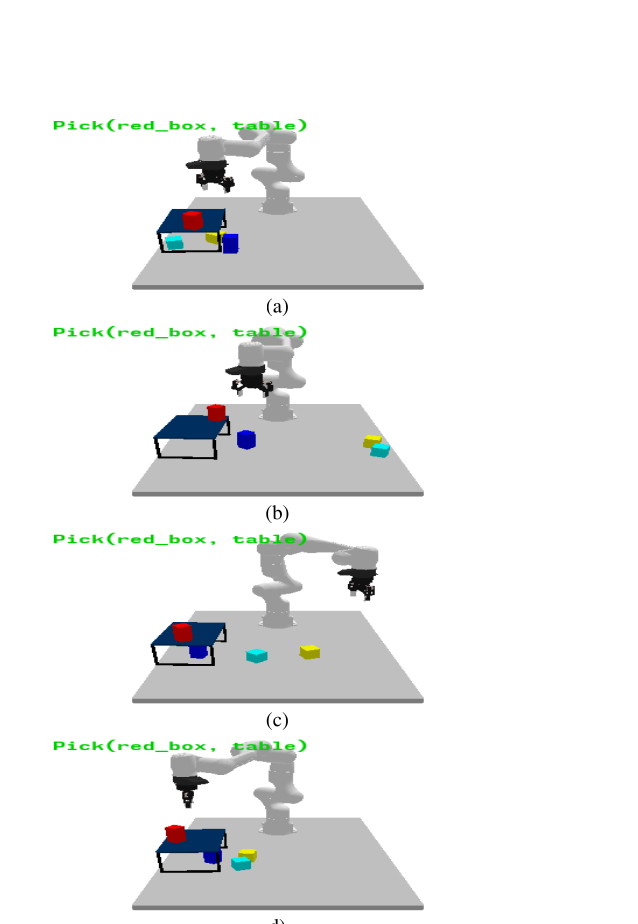
We build upon existing task and motion planning (TAMP) frameworks by integrating pre-trained Sequencing Task-Agnostic Policies (STAP) and Effort Level Search (ELS) to create a hierarchical approach that decouples high-level task decisions from low-level motion execution. The method incorporates a novel success rate estimator that provides more accurate task success predictions than traditional Q-value estimators, and leverages the infinite completion tree structure of ELS to dynamically adjust computational resources based on task complexity. Empirical results demonstrate significant improvements in planning efficiency and execution reliability over traditional methods.

RoboArm-NMP: a Learning Environment for Neural Motion Planning

T Jurgenson, M Sudry , G Avineri, A Tamar

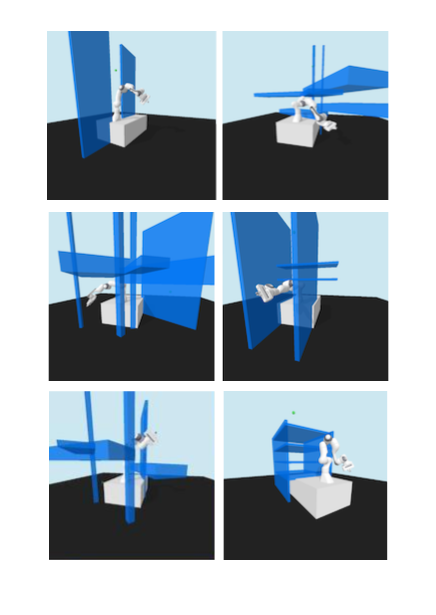
We present RoboArm-NMP, a learning and evaluation environment that allows simple and thorough evaluations of Neural Motion Planning (NMP) algorithms, focused on robotic manipulators. Our Python-based environment provides baseline implementations for learning control policies (either supervised or reinforcement learning based), a simulator based on PyBullet, data of solved instances using a classical motion planning solver, various representation learning methods for encoding the obstacles, and a clean interface between the learning and planning frameworks. Using RoboArm-NMP, we compare several prominent NMP design points, and demonstrate that the best methods mostly succeed in generalizing to unseen goals in a scene with fixed obstacles, but have difficulty in generalizing to unseen obstacle configurations, suggesting focus points for future research.

Hierarchical Planning for Rope Manipulation using Knot Theory and a Learned Inverse Model

CORL 2023

M Sudry, T Jurgenson, A Tamar, E Karpas

This work considers planning the manipulation of deformable 1-dimensional objects, such as ropes or cables, specifically to tie knots. We propose TWISTED: Tying With Inverse model and Search in Topological space Excluding Demos, a hierarchical planning approach which, at the high level, uses ideas from knot-theory to plan a sequence of rope configurations, while at the low level uses a neural-network inverse model to move between the configurations in the high-level plan. To train the neural network, we propose a self-supervised approach, where we learn from random movements of the rope. To focus the random movements on interesting configurations, such as knots, we propose a non-uniform sampling method tailored for this domain. In a simulation, we show that our approach can plan significantly faster and more accurately than baselines. We also show that our plans are robust to parameter changes in the physical simulation, suggesting future applications via sim2real.

Learning To Estimate Search Progress Using Sequence Of States

ICAPS 2022

M Sudry, E Karpas

Many problems of interest can be solved using heuristic search algorithms. When solving a heuristic search problem, we are often interested in estimating search progress that is, how much longer until we find a solution. Previous work on search progress estimation derived formulas based on observable features of the search algorithm's behavior. In this paper, rather than manually deriving such formulas, we leverage machine learning to automatically learn more accurate search progress predictors. We train a Long Short-Term Memory (LSTM) network, which takes as input sequences of nodes expanded by the search algorithm and predicts how far along in the search we are. Importantly, our approach still treats the search algorithm as a black box and does not look into the contents of search nodes. An empirical evaluation shows that our technique outperforms previous search progress estimation techniques.